RocketFuel Marketing

Is cold emailing illegal?

Get the facts on cold email rules, then build outreach that earns qualified conversations while staying on the right side of them.

Short answer

U.S. law says cold emailing is allowed if you follow CAN-SPAM: include a working return address, keep it working for at least 30 days, and stop emailing people within 10 business days of their opt-out request. (15 U.S.C. 7704 (CAN-SPAM)) The UK is stricter: you must not send marketing emails to individuals without specific consent, except to past customers for similar products or services who got a simple opt-out. (ICO guide to PECR: electronic mail marketing (UK)) This post is general information, not legal advice.

Why the answer is "it depends"

It is worth checking the local rules that apply to you and your recipients, since approaches to unsolicited business email can differ from place to place. Each country or region sets its own requirements. Some rules are stricter for emails to individuals than for emails to business contacts. (ICO) Before you send, check the rules in each place you plan to email, and ask a qualified lawyer if you are unsure.

U.S. and UK rules side by side

U.S. and UK rules side by sideU.S. (CAN-SPAM): Cold email allowed, then Working return address, then Stop within 10 business days. UK (PECR): Consent to email individuals, then Past customers can be emailed, then Simple opt-out every time.U.S.(CAN-SPAM)Cold email allowedWorking return addressStop within 10 businessdaysUK (PECR)Consent to emailindividualsPast customers can beemailedSimple opt-out every timeU.S. and UK rules side by sideU.S. (CAN-SPAM): Cold email allowed, then Working return address, then Stop within 10 business days. UK (PECR): Consent to email individuals, then Past customers can be emailed, then Simple opt-out every time.U.S. (CAN-SPAM)Cold email allowedWorking return addressStop within 10 business daysUK (PECR)Consent to email individualsPast customers can be emailedSimple opt-out every time
The U.S. allows cold email if you follow CAN-SPAM. The UK is stricter for emails to individuals.

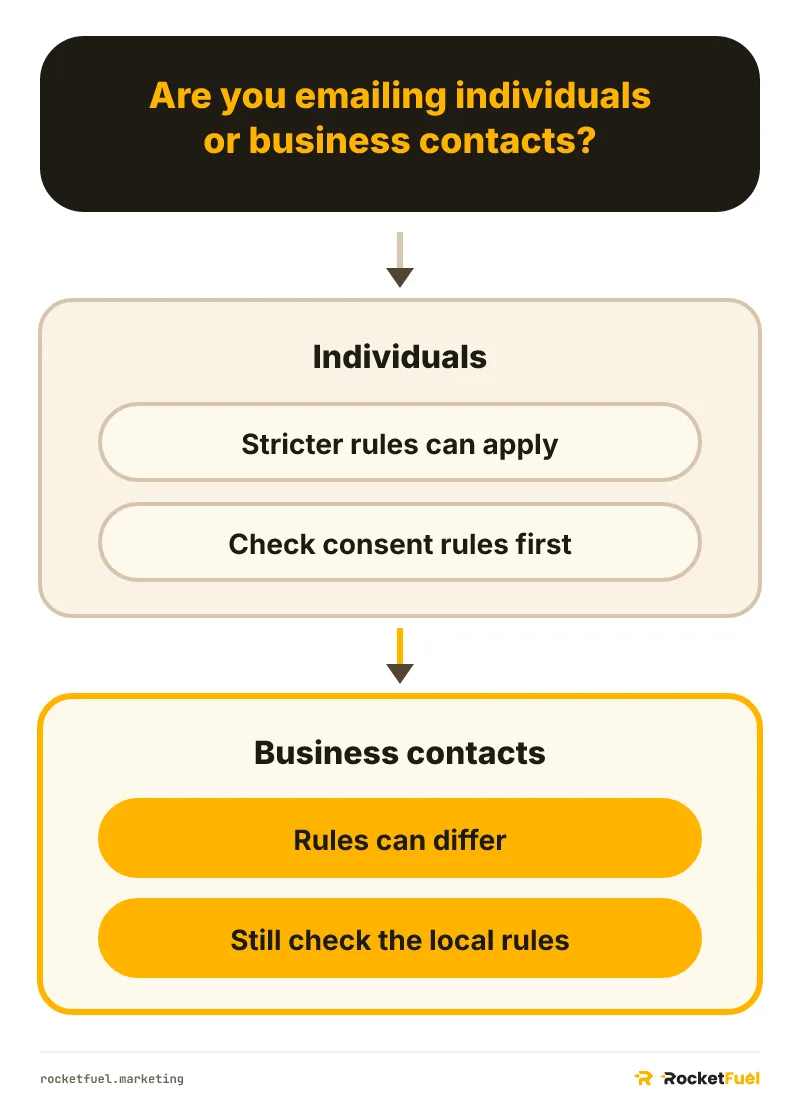
Who are you emailing?

Who are you emailing?Are you emailing individuals or business contacts? Individuals: Stricter rules can apply; Check consent rules first. Business contacts: Rules can differ; Still check the local rules.Are you emailing individuals or businesscontacts?IndividualsStricter rules can applyCheck consent rules firstBusiness contactsRules can differStill check the local rulesWho are you emailing?: Are you emailing individuals or business contacts? Individuals: Stricter rules can apply; Check consent rules first. Business contacts: Rules can differ; Still check the local rules.
Some rules are stricter for emails to individuals than for emails to business contacts.

What the rules usually cover

Anti-spam and privacy laws tend to focus on a few areas:

What the rules usually cover
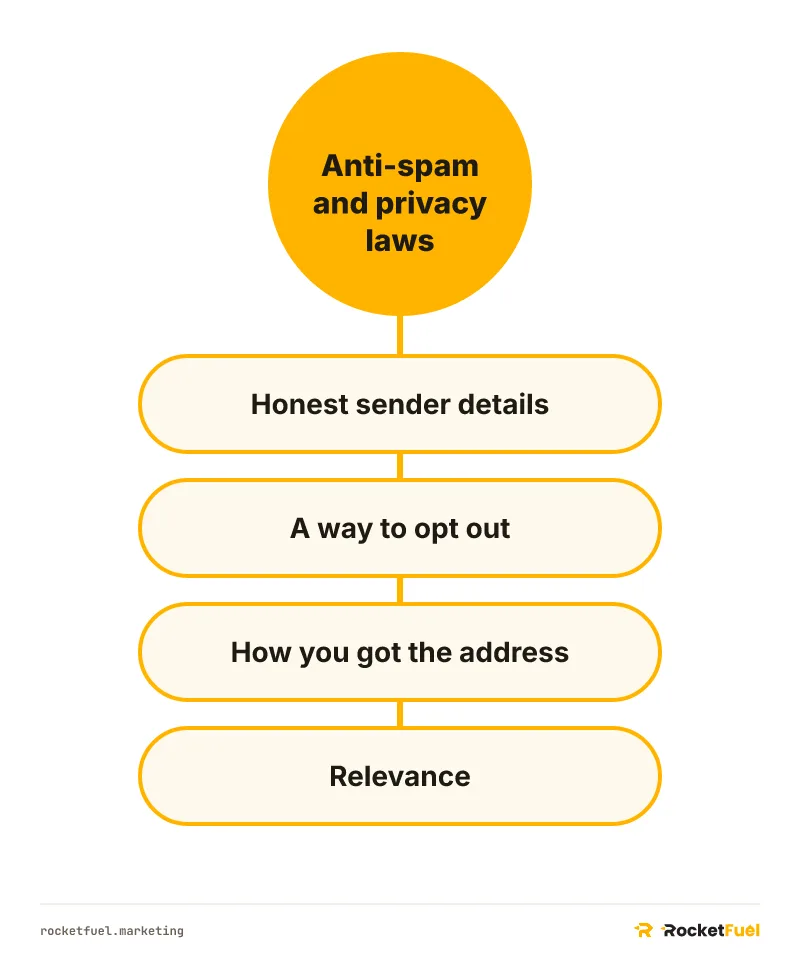
What the rules usually coverAnti-spam and privacy laws: Honest sender details, A way to opt out, How you got the address, Relevance.Honest senderdetailsA way to opt outHow you got theaddressRelevanceAnti-spam andprivacy lawsWhat the rules usually cover: Anti-spam and privacy laws: Honest sender details, A way to opt out, How you got the address, Relevance.
Anti-spam and privacy laws tend to focus on four areas.

Honest sender details. The message should not hide who you are or mislead people about why you are writing.

A way to opt out. Recipients should be able to tell you to stop, and you need to honor that request. (15 U.S.C. 7704)

How you got the address. Privacy rules can limit how you collect and use personal data.

Relevance. Messages sent to people with no connection to your offer are the ones most likely to cause problems.

Practical habits that lower your risk

  • Email people who have a plausible business reason to hear from you.
  • Identify yourself and your company clearly.
  • Include a simple way to opt out, and act on it quickly.
  • Keep a suppression list so nobody who opted out gets emailed again.
  • Keep records of where your contact data came from.
  • Ask a qualified lawyer to review your process, especially if you email across borders.

Habits before you send

Habits before you send1. Email people with a business reason; 2. Identify yourself and your company; 3. Include a simple opt-out; 4. Record where the data came from; 5. Ask a lawyer to review.1Email peoplewith a businessreason2Identifyyourself andyour company3Include a simpleopt-out4Record where thedata came from5Ask a lawyer toreviewHabits before you send1. Email people with a business reason; 2. Identify yourself and your company; 3. Include a simple opt-out; 4. Record where the data came from; 5. Ask a lawyer to review.1Email people with abusiness reason2Identify yourself andyour company3Include a simple opt-out4Record where the datacame from5Ask a lawyer to review
Simple habits that lower your risk on every campaign.

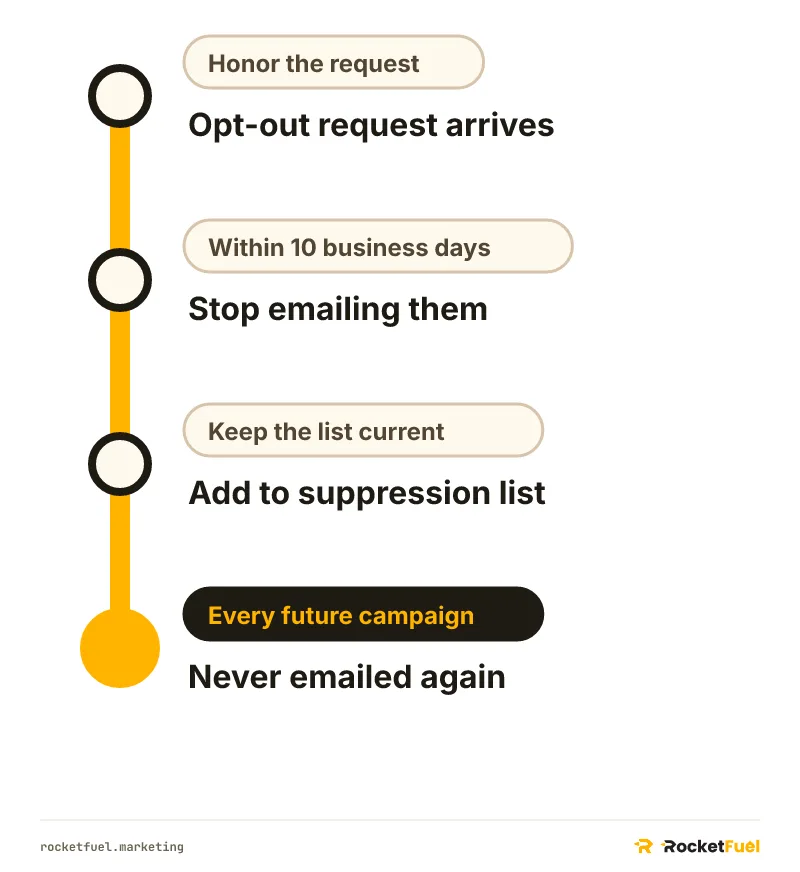
When someone opts out

When someone opts out1. Opt-out request arrives (Honor the request); 2. Stop emailing them (Within 10 business days); 3. Add to suppression list (Keep the list current); 4. Never emailed again (Every future campaign).Honor the requestOpt-out requestarrivesWithin 10 business daysStop emailingthemKeep the list currentAdd tosuppression listEvery future campaignNever emailedagainWhen someone opts out: 1. Opt-out request arrives (Honor the request); 2. Stop emailing them (Within 10 business days); 3. Add to suppression list (Keep the list current); 4. Never emailed again (Every future campaign).
Act on opt-outs quickly and keep a suppression list so nobody is emailed again.
FAQ

Frequently asked questions

Is cold emailing legal?

U.S. law says cold emailing is allowed if you follow CAN-SPAM: include a working return address, keep it working for at least 30 days, and stop emailing people within 10 business days of their opt-out request. (15 U.S.C. 7704 (CAN-SPAM)) The UK is stricter: you must not send marketing emails to individuals without specific consent, except to past customers for similar products or services who got a simple opt-out. (ICO guide to PECR: electronic mail marketing (UK))

Do the rules differ for business and personal email addresses?

They can. Some rules treat emails to individuals more strictly than emails to business contacts. Check the rules for each region you email.

Do I need an unsubscribe option?

Offering a clear way to opt out and honoring requests is widely recommended and is often legally required. (15 U.S.C. 7704 (CAN-SPAM)) It is worth checking the rules where your recipients are.

Should I get legal advice before starting?

Yes, especially if you email across borders. A qualified lawyer can review your process against the laws that apply to you.

Legal and effective are different things

A message can be legal and still perform badly, or damage your sender reputation. Targeting, relevance, and honesty help with both compliance and results. RocketFuel builds these habits into every campaign through its Client Machine™ system.

If you would rather not run outreach yourself, see our cold email agency page. An agency does not remove your legal responsibility, so ask any provider how they handle compliance.

Legal is not the same as effective

Legal is not the same as effectiveLegal only: Follows the rules; Can still perform badly; Can damage sender reputation. Legal and effective: Targeted at the right people; Relevant to the reader; Honest about who you are.Legal onlyFollows the rulesCan still perform badlyCan damage sender reputationLegal and effectiveTargeted at the right peopleRelevant to the readerHonest about who you arevsLegal is not the same as effectiveLegal only: Follows the rules; Can still perform badly; Can damage sender reputation. Legal and effective: Targeted at the right people; Relevant to the reader; Honest about who you are.Legal onlyFollows the rulesCan still perform badlyCan damage sender reputationvsLegal and effectiveTargeted at the right peopleRelevant to the readerHonest about who you are
Targeting, relevance and honesty help with both compliance and results.
Book a call

Book your strategy call

A 30-minute strategy call. Times are shown in your time zone.

Calendar not loading? Open the booking page